
HARMONIZE presented at the Prince Madihol Award Conference in Thailand
JAN 4 2023
Rachel Lowe took part in a special event at PMAC in Bangkok, Thailand on ‘Innovative Data Platforms and Tools for Monitoring Environmental and Health Threats: Lessons from Low- and Middle-Income Countries’ organised by the Rockefeller Foundation. The goal of the session was to discuss the lessons learned and highlight the tools using data science and epidemiologic models to respond to climate-sensitive diseases, as a broader part of the global health discourse on pandemic prevention.
The Rockefeller Foundation hosted a special side event on Climate Change and Infectious Disease at the Prince Mahidol Award Conference (PMAC) in Bangkok, Thailand on 25 January 2023. The event, entitled ‘Innovative Data Platforms and Tools for Monitoring Environmental and Health Threats: Lessons from Low- and Middle-Income Countries’, aimed to highlight how advances in modelling and data science have provided actionable tools for public health decision-makers to respond to climate-sensitive diseases, as a broader part of the global health discourse on pandemic prevention. The event was facilitated by Dr. Bruce Gellin, Senior Vice President, Health Initiative, Rockefeller Foundation and included the following panellists:
Rachel Lowe, ICREA Research Professor, Barcelona Supercomputing Center (Spain)
Regina Justina E. Estuar, Professor, Ateneo Social Computing Science Lab (Philippines)
Raghu Dhamaraju, President, Art Park (India)
Manoel Barral-Netto, Professor, Fiocruz (Brazil)
The session provided an overview of projects underway in Thailand, India and Brazil that demonstrate the value of integrating traditional public health data with data not used traditionally by public health officials (e.g., weather, mobility, social media, consumer behaviour data) to inform actionable and targeted public health interventions in Low- or Middle-Income Countries (LMICs). Rachel Lowe also presented the HARMONIZE project, highlighting the data collection and harmonisation initiatives taking place across Latin America and the Caribbean and the work being conducted in the HARMONIZE hotspots to integrate ground truth data from drones and weather stations deployed by the project in the Colombian Andes, the Dominican Republic, the Peruvian and Brazilian Amazon and the semi-arid region of Northeast Brazil. The projects presented in the session covered multiple infectious diseases with a focus on dengue fever as a use case and the co-creation of data products and models with local communities. The session provided an opportunity to share key learning and insights from action on the ground that validate the feasibility and desirability of a data and analytics driven approach to assess and respond to climate-sensitive infectious diseases.
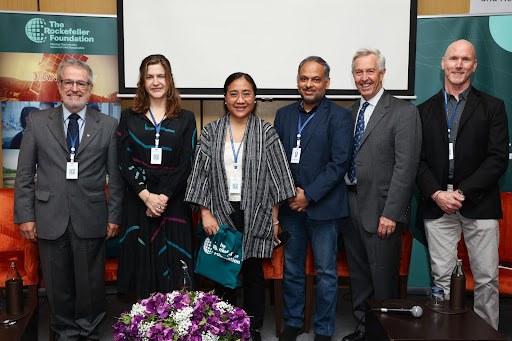
Rachel Lowe with fellow panelists and chairs at the Rockefeller PMAC side event in Bangkok.